
The art of the triptych: creating perfect multi-part images
From the WhiteWall expert Jan-Ole Schmidt
Three images – one motif: the triptych is one of the most impressive forms of photographic presentation. It brings structure to large-scale wall designs, tells stories in stages, and gives images a new depth. The appeal lies in the combination of unity and variation – a motif divided into three segments develops its own unique expressiveness in this arrangement.
Originally coming from sacred art, the triptych has long since established itself as a contemporary design element – in art, design, and especially in photography. It is precisely through the division into three parts that exciting effects can be achieved: repetitions, variations, changes in focus or light – and yet, in the end, a harmonious whole is created.
Whether as a large-format wall design, a calming structural element in open living spaces, or a focused ensemble in a hallway, dining area, or office, a triptych brings visual balance and aesthetic clarity. It is an exciting design tool for both experienced photographers and beginners alike to present their own motifs in a stylish and effective way.
In this article, we show you how to design a triptych, which motifs are important, what you should consider when choosing the format and hanging it – and which WhiteWall products are particularly suitable for this.
1. What is a triptych? Origin and current use

The word "triptych" comes from Greek ("tri" = three, "ptyché" = fold) and originally referred to a three-part work of art consisting of a central panel and two side panels. Triptychs were particularly widespread in medieval sacred art, mostly as altarpieces depicting thematically related scenes. The form allowed a central message to be emphasized and at the same time deepened by complementary elements.
Today, the triptych has moved away from its purely religious significance and has become a valued form of presentation in contemporary art and photography. The tripartite division appears balanced and clear, offering scope for creative experimentation.
Triptych in photography

In photography, a triptych can take various forms:
A continuous motif that is cut into three parts
Three independent images with a connecting theme
A deliberate intensification or variation of details within a series
The advantage of this arrangement lies in its structural clarity: three images can be arranged symmetrically or slightly offset and fit perfectly on walls of medium to large width. At the same time, the tripartite division creates a natural visual balance that can have a strong effect in almost any room – from the living room to the gallery.
A modern classic, then, that is suitable for both experimental and classic motifs – and is particularly impressive when combined with high-quality printing and presentation formats.
2. Motif selection: What is suitable for a triptych?

The decision to use a triptych begins with the choice of motif – because not every image unfolds its full effect in a three-part format. It is important that there is either a contextual connection, a graphic rhythm, or visual continuity between the segments.
Panoramas and landscapes

Expansive motifs such as beach landscapes, mountain ranges, or city skylines are ideal:
They can be divided harmoniously into three sections
The parts of the image build on each other visually and convey a sense of vastness
Particularly effective with calm horizons or clear lines
Abstract structures and detailed shots

If you enjoy working with patterns, colors, and textures, you can split a single motif graphically or place three related motifs side by side.
Ideal for natural details (leaves, sand, water surfaces)
Architectural details or surface structures are also suitable
Portraits and narrative series

A portrait can gain new depth through tripartite division—e.g., as a sequence of movements or emotions. A mini-reportage consisting of three moments from a day or event can also be staged impressively.
Planning tip
Ensure smooth transitions for continuous motifs – the main motif should not be located exactly in the intersection area.
For three different images: create a visual link through color, lighting, or format
It is best to create a digital sketch in advance or print out your selection in small format to test the effect of the combination.
A successful triptych is more than the sum of its parts—it is a visual narrative with structure, depth, and tension.
3. Design principles for harmony in triptychs

A triptych thrives on balance—between the individual parts of the image as well as in its overall effect on the wall. To ensure that the ensemble appears deliberately composed rather than random, a few basic design principles should be taken into account.
Choice of format and size ratio
A triptych looks particularly harmonious when all three parts of the picture are the same size and format.
In asymmetrical arrangements, the side images can be slightly narrower – the important thing is to achieve visual balance.
Popular formats are portrait (e.g., 3×30x90 cm) or landscape (e.g., 3×60x40 cm).
Spacing and proportions when hanging
There should be an even distance of approx. 5 to 10 cm between the pictures – depending on the format and wall size.
The distance to the ceiling, furniture, or wall edge should be chosen carefully—ideally, the triptych should form a closed center on the wall.
Keep the color and lighting mood consistent

With three individual motifs, a visual link is important: a common color scheme, similar lighting, or design elements such as lines or structures.
With a continuous motif, the color and brightness distribution must remain harmonious in all segments—image editing helps to smooth transitions.
Symmetrical or asymmetrical?

A symmetrical arrangement is classic, calm, and clear—perfect for central walls, above sofas, or beds.
An asymmetrical hanging (e.g., an ascending line or slightly offset heights) appears more creative and is suitable for modern, open-plan living spaces.
With the right design, the triptych becomes not only a decorative eye-catcher, but also an expressive element of the room's architecture – precisely composed yet lively.
4. Technical implementation: From digital design to finished wall art

The aesthetic effect of a triptych stands and falls with its clean technical implementation. From the initial image design to precise production and hanging, one thing is certain: attention to detail pays off.
Image editing for a uniform effect
Use programs such as Adobe Lightroom or Photoshop to coordinate the colors of the image sections.
Pay attention to consistent tonal values, contrasts, and exposure - especially for individual motifs that are intended to appear as a series.
For continuous panoramas, it is advisable to edit the entire image first and then divide it up.
Division into segments of equal size
Work with a clear grid division: e.g., into thirds for a horizontal or vertical motif.
Make sure that important image elements are not located exactly in the cut area.
Export each segment as a separate file with identical resolution and format specifications.
File preparation for printing
WhiteWall supports a wide range of formats and materials – from classic photo paper to acrylic glass and aluminum Dibond.
Ensure high resolution (at least 150 dpi in print format, preferably 300 dpi).
Check the alignment and margins in the configurator – this is particularly important for full-bleed motifs.
Tip: Virtual first, then real
Use digital mock-ups or visualization programs to simulate the triptych in the room in advance.
This allows you to assess the size, spacing, and image effect before printing and adjust them if necessary.
A technically clean file guarantees that your triptych not only looks good, but can also be produced precisely and to a high standard – in line with professional wall design.
5. WhiteWall product tips for modern triptychs

A successful triptych depends not only on the choice of motif and composition, but also on the right presentation. WhiteWall offers a wide range of high-quality materials and options for creating three-part picture series in a variety of styles – from purist and modern to artistic and expressive.
All WhiteWall products – unlimited freedom for your design
Whether acrylic glass, aluminum Dibond, or framed Fine Art Prints: all WhiteWall products are basically suitable for creating a triptych.
Acrylic glass ensures vibrant colors and impressive depth – ideal for modern interiors or color-intensive motifs.
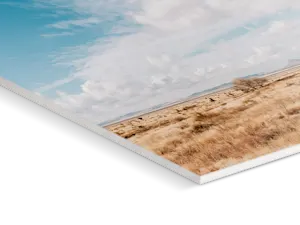
Aluminum Dibond impresses with its matte surface and high stability – particularly popular for minimalist or monochrome series.
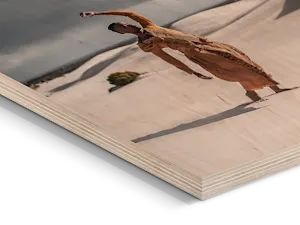
Framed pictures have a classic, high-quality look – we recommend a subtle frame so that the frame does not distract from the motif.
Design multi-part images directly – precisely and conveniently

With the WhiteWall configurator, multi-part images can be easily designed online. The motif is automatically divided into segments of equal size – perfect for symmetrically structured triptychs.
Choose between a diptych, triptych, or larger division
Freely selectable materials, sizes, and spacing
More information about multi-part images
Round formats as a creative alternative

For those who want to break away from classic rectangular formats, round formats offer an exciting alternative.
Three round images, e.g., with floral motifs, color gradients, or abstract patterns, create an extraordinary triptych.
Particularly effective in modern, open spaces with a high degree of design freedom
The combination of shape and series brings a playful lightness to the wall.
More information about photos in round formats
Conclusion: Triple effect with depth

A triptych is more than just a decorative idea—it is a form of artistic expression that combines structure and emotion. The three-part division creates visual tension, directs the eye, generates rhythm, and provides space for narrative or aesthetic depth.
Whether it's a continuous panorama, thematically linked individual motifs, or experimental formats such as circular images: with good planning, harmonious design, and high-quality execution, the triptych becomes the architectural and artistic focal point of the room.
WhiteWall not only offers you first-class print quality and premium materials, but also the creative freedom to realize your personal triptych exactly as you envision it—whether classically framed, modern behind acrylic, or creatively staged in multiple parts.
This creates a powerful whole from three images – and a lasting impression from a single motif.
Learn more about the author
Jan-Ole Schmidt (better known simply as Ole) is from northern Germany and has been with WhiteWall for many years. As a team leader in product management, he brings extensive experience in the photography industry. He taught himself photography and has built up in-depth expertise in image production, papers, laminations, and framing.
His strength lies in the combination of technical expertise and customer perspective - from file upload to framing in the WhiteWall configurator. Ole has held workshops, been a guest on podcasts and is in close contact with the photography community. He lives, works and photographs in Cologne.

WhiteWall Product Recommendations


We’re Happy To Help
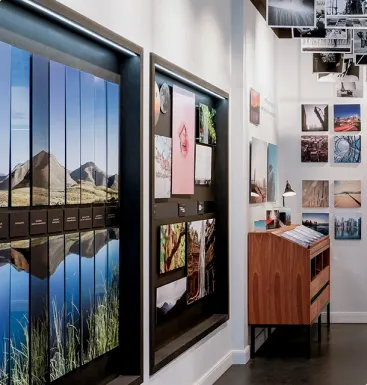
Stores Need assistance?Our team will help you select the perfect products!Discover Now
Customer Service Feel free to call us at +1 646 513 44 22 or send us an email at info@whitewall.com.Digital appointment
Gift Certificates The Right Photo GiftDiscover Now
