
Tips for hanging and arranging photos
From the WhiteWall expert Jan-Ole Schmidt
An expressive photo deserves more than just any old spot on the wall—because how a picture is presented has a decisive influence on how it is perceived. The choice of material, format, and print quality are essential—but just as important is how it is hung and arranged in the room.
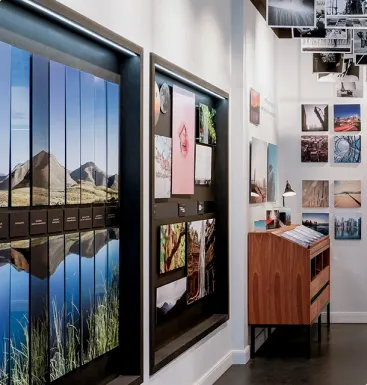
A carefully composed wall concept can transform rooms, enhance moods, and create a real wow effect. It's about relating the picture to the space: Which wall area is emphasized? How do colors and light work? Which hanging style suits the type of room or furniture?
Whether you are staging a single work or designing an entire picture wall, with a few basic design principles and an eye for proportions, you can create a presentation that is much more than mere decoration: a visual stage for your favorite motifs.
In this article, we show you how to arrange your pictures stylishly, harmoniously, and effectively—from a single piece to a gallery. And, of course, we also introduce you to the right WhiteWall products that turn every presentation into a high-quality design statement.
1. The right height – the line of sight as a basis

No matter how well chosen or printed an image is, it can lose its impact if it is hung at the wrong height. The most important rule here is simple – but crucial: pictures should be hung at eye level. This so-called "line of sight" ensures that the image is perceived naturally and blends harmoniously into the room structure.
The rule of thumb: eye level as standard
A height of approximately 145 to 150 cm from the floor to the center of the picture is a good guideline, depending on the height of the occupants. This corresponds to the average eye level when standing and creates a pleasant viewing angle.
Special features depending on the type of room
Living room or dining room: People usually spend time here sitting down. Adjust the hanging accordingly – pictures can be hung a little lower, at a height of around 120–135 cm.
Hallways or stairwells: In continuous areas, you can play with varying heights. It is important that the eye finds a natural path, especially on staircases.
Offices or workspaces: The viewing angle varies greatly. Here, it is worth adjusting the height to the seating area or workspace.
What applies to group hanging?

Even with a group of pictures, the overall ensemble should be oriented towards eye level – usually the center axis of the grouping is set at eye level.
A picture at the right height not only looks balanced – it is also consciously perceived as part of the interior design, not as a randomly placed element.
2. Put individual pictures in the spotlight

A single picture can define an entire room – provided it is placed effectively. Large-format photographs in particular have a strong presence when they are freestanding or hung on a clearly defined wall surface. But even smaller formats can shine as solitaires if they are chosen and staged with care.
Large formats with spatial effect

A large-format Fine Art Print or acrylic glass picture is perfect for centrally positioned walls:
Above the sofa
Behind the dining table
In hallways with clear lines of sight
Such solitary pieces attract attention – they give the room a visual center and define its atmosphere.
Small formats with character

Even smaller formats can have a strong impact when hung in isolation on a free surface – e.g., an atmospheric black-and-white portrait in a classic passe-partout frame on a colored wall. Important: Leave enough space around the picture to allow it to take effect.
Lighting for maximum effect
Light is the silent partner of good image presentation.
Gallery spotlights or targeted accent lighting dramatically highlight the subject.
Indirect light from wall or ceiling lights creates soft transitions and depth.
With glossy materials such as acrylic glass or Fine Art Pearl, it is crucial to avoid direct reflections.
Tip for selection
In quiet rooms: strong motifs with great depth or clear composition
In dynamic environments: calmer motifs that create structure and orientation
A single image can become an eye-catcher – if it is given space and the staging is right.
3. Arrange groups of images correctly

Groups of pictures create dynamism, tell stories, and offer scope for creative design. They turn a wall into a visual collage and allow different motifs, colors, and formats to be combined harmoniously. However, to ensure that such an arrangement does not appear arbitrary, it needs a well-thought-out concept.
Symmetry or free arrangement?

The choice of arrangement depends on the style of the room and the desired effect:
Symmetrical hangings (e.g., grids or rows) create a calm, structured, and orderly effect - ideal for classic, minimalist, or geometrically designed rooms.
Free hanging (e.g., Petersburg hanging or organic groupings) creates liveliness and has a particularly personal effect – perfect for creative, cozy, or artistic environments.
An overview of popular hanging styles
Row hanging: Perfect for pictures of the same size, e.g., in the hallway or above the sofa
Grid hanging: Particularly harmonious with uniform frames and formats – for example, four pictures in two rows
Petersburg hanging: The free, often densely hung gallery arrangement – charmingly chaotic, especially on colored walls
Edge hanging: All pictures are aligned along a line (top or bottom) – ensures clarity despite a mix of formats
How to plan a picture wall

Before hammering nails into the wall, it helps to plan visually:
Cut out paper templates of the picture formats and attach them to the wall with masking tape
Alternatively: create a digital sketch in the floor plan or using an app
The overall composition should function as a unified visual field – with even spacing (usually 5–8 cm) and a visual center
A well-planned group of pictures not only adds excitement to the wall – it also gives the room depth, rhythm, and personality.
4. Combine formats and spacing cleverly

Combining different picture formats gives a picture wall dynamism, character, and depth. But to ensure that the result does not appear restless, a well-thought-out balance of size, shape, and spacing is required. Especially when hanging groups of pictures, these subtleties are crucial for a harmonious overall impression—and thus for the wow effect.
Play with portrait and landscape formats
Different orientations bring movement to the composition
It is important to create visual balance – e.g., by having a clear center or symmetrically balanced edges
Vertical images visually stretch a group, horizontal ones give it width
Use size variation deliberately

A large image as a central element around which smaller motifs are grouped gives the wall structure
Alternatively: Several medium-sized formats distributed evenly – particularly harmonious with row or grid hangings
Small formats such as WhiteWall Minis can be arranged in groups to create creative mosaics
Spacing: Less is more—but not too little

Hanging pictures too close together makes the wall look crowded
Spacing that is too large destroys the cohesion of the group
Ideal: 5–8 cm spacing between pictures – depending on the format
For large formats, the spacing can be a little more generous to give the picture room to breathe
Tip for beginners
An invisible grid is a useful tool: imagine an imaginary line or rectangle into which all formats fit – this creates a harmonious overall effect, even with different sizes and frame types.
The deliberate combination of formats and spacing turns a collection of pictures into a compositionally strong wall design – with plenty of room for individuality.
5. Wall design with a concept – Think thematically and stylistically

Picture walls have the greatest impact when they are not only well hung, but also well thought out in terms of content and style. The choice of motifs, colors, papers, and frames should not be left to chance – but should follow a clear, design idea. This turns the wall into a real design concept that underlines the personality of the room and its inhabitants.
Themes create connections
Group pictures according to common themes: for example, travel, nature, family moments, or abstract structures.
Color themes also create visual coherence – e.g., a series in sepia, black and white, or coordinated pastel shades
Think in terms of stories: a hanging can visually guide you through the seasons, show a series of places, or tell the story of a day in snapshots
Stylistic unity as a visual bracket
Uniform frames and passe-partouts create a calm overall picture, even with different motifs
Different frames can be deliberately combined – it is important that they complement each other in terms of shape, color, or material
The choice of printing material also influences the effect: canvas for warm, soft imagery, acrylic glass for
brilliant colors and modern radiance, Fine Art Prints for artistic motifs with a textured surface
Combining art, photography, and illustration

A special tension arises when different visual media are combined – for example:
An abstract illustration next to a minimalist photograph
A child's drawing in a passe-partout next to an elegant Fine Art Print
Typographic motifs as a calm counterpoint to colorful photographs
Important: The overall composition remains crucial—even when mixing styles, there should be a connecting element: the same frame color, a recurring format, or a common theme. This creates not just a wall of pictures, but a room full of ideas, stories, and character.
6. WhiteWall product tips for creative hanging
In addition to the right idea, a compelling image presentation also requires high-quality materials that blend harmoniously into the interior – or deliberately create stylistic contrasts. WhiteWall offers a wide range of products that are ideal for creative, modern, and individual hanging. Here are some particularly inspiring recommendations:
WhiteWall Minis – Perfect for modular gallery walls

The square photo tiles are ideal for anyone who wants flexible design options:
Easy to attach without drilling thanks to the adhesive system
Easily expandable – ideal for growing series or themed collections
Particularly suitable for modern collages, photo mosaics, or small wall spaces with a big impact
Perfect for trying out initial gallery concepts on small surfaces or in hallways
More information about photo displays made of acrylic glass
Changeable Magnetic Frame – decorate with dynamism

If you like to redesign your walls regularly or adapt them to the seasons, Changeable Magnetic Frames are the ideal solution:
Motifs can be exchanged in just a few simple steps
Stylish aluminum frame, unobtrusive and timeless
Perfect for changing seasonal motifs, children's drawings, quotes, or your own photo art
More information about photos in changeable magnetic frames
Floater Frame – For that gallery look at home

This frame gives your picture a particularly elegant look, because:
The photo appears to "float" in the frame – an effect that creates depth
Ideal for large-format works, acrylic glass pictures, or modern interiors
A highlight for anyone who values clean lines and a professional look
More information about photos in floater frames
Passe-partout frame – Classic, elegant, timeless

The passe-partout frame is ideal for a calm, artistic presentation:
Emphasizes the motif through visual space
Available in various wood colors and frame profiles
Particularly stylish for portraits, black-and-white photographs, or historical motifs
More information about photos in passe-partout frames
Whether minimalist or playful, classic or avant-garde – with the right WhiteWall products, you can create wall designs that transform the room and put your photographic art in the spotlight.
Round formats – for extraordinary accents

If you want to break out of the rectangular mold, WhiteWall's round formats offer an extraordinary option:
Available in various sizes – ideal as a single piece or in a cluster
Particularly effective for nature photographs, graphic motifs, or minimalist compositions
A stylish break from classic formats – modern and surprising
More information about photos in round formats
Multi-part images – for large walls and powerful stories

For rooms with large wall spaces, multi-part images offer an impressive way to reimagine photography:
A motif is spread across several image carriers – e.g., as a triptych or quadrant
Enhances the artistic impression and brings movement to large rooms
Ideal for panoramas, abstract photography, or atmospheric nature shots
More information about multi-part images
Conclusion: Planning, courage, and quality create the wow effect

A harmoniously hung picture or a carefully composed gallery can do more than just fill walls—it brings personality to a room, creates atmosphere, and makes photography a living part of the interior design. The wow effect is created not only by the motif, but also by the interplay of height, arrangement, format choice, and material.
Whether as a single eye-catcher or a lively picture wall, whether hung in a clear geometric pattern or arranged playfully and freely – with a little planning, creative courage, and high-quality WhiteWall products, you can create unique presentations.
Learn more about the author
Jan-Ole Schmidt (better known simply as Ole) is from northern Germany and has been with WhiteWall for many years. As a team leader in product management, he brings extensive experience in the photography industry. He taught himself photography and has built up in-depth expertise in image production, papers, laminations, and framing.
His strength lies in the combination of technical expertise and customer perspective - from file upload to framing in the WhiteWall configurator. Ole has held workshops, been a guest on podcasts and is in close contact with the photography community. He lives, works and photographs in Cologne.

WhiteWall Product Recommendations


We’re Happy To Help
Stores Need assistance?Our team will help you select the perfect products!Discover Now
Customer Service Feel free to call us at +1 646 513 44 22 or send us an email at info@whitewall.com.Digital appointment
Gift Certificates The Right Photo GiftDiscover Now
